
Many elementary teachers have seen it happen: a student reads every word on the page but cannot explain what the text means. That gap is exactly why learning how to teach reading comprehension matters so much. Decoding is only one part of reading. Students also need to connect ideas, make predictions, ask questions, and explain their thinking in simple, clear ways. In busy classrooms, that can feel like one more thing to fit into an already packed schedule. So where do you start? The good news is that strong comprehension instruction does not require complicated programs or endless prep. With a few consistent routines, the right classroom resources, and short, meaningful practice, elementary teachers can build comprehension skills across grade levels. This guide breaks down practical ways to teach reading comprehension so students become more confident, thoughtful readers.
Table of Contents
- Why reading comprehension matters in elementary school
- Core strategies to teach reading comprehension effectively
- Classroom routines and activities that build comprehension skills
- How to support different learners without adding extra stress
- Common mistakes to avoid when teaching comprehension
Why Elementary Teachers Need to Teach Reading Comprehension Explicitly
To teach reading comprehension well, it helps to remember that understanding a text is not automatic. Many students can read aloud with accuracy, yet still struggle to identify the main idea, explain character actions, or draw conclusions. That is why comprehension must be taught directly, modeled often, and practiced in small steps.
In elementary school, comprehension supports every subject area. Students use it in reading workshop, science articles, math word problems, and social studies texts. When teachers build comprehension skills early, students are better prepared to work independently and talk about their thinking with confidence.
Comprehension is more than answering questions
Sometimes comprehension instruction becomes a worksheet routine: read the passage, answer the questions, move on. But real understanding goes deeper. Students need to visualize, infer, summarize, and connect ideas to what they already know. They also need to explain how they found an answer, not just circle the correct choice.
Young readers benefit from think-alouds
One of the simplest ways to teach reading comprehension is by making your thinking visible. During a read-aloud, pause and say things like, “I think the character is worried because of what happened on the last page,” or “This heading helps me predict what I will learn next.” These quick models show students what skilled readers actually do. Have you ever noticed how much stronger student responses become after hearing a teacher model the process first?
Reading Strategies That Help You Teach Reading Comprehension
The best way to teach reading comprehension is to focus on a few powerful reading strategies and revisit them often. Instead of introducing too many skills at once, choose one strategy, model it clearly, then give students guided and independent practice. This keeps lesson planning manageable and helps students build stronger habits over time.
Start with predicting, questioning, and summarizing
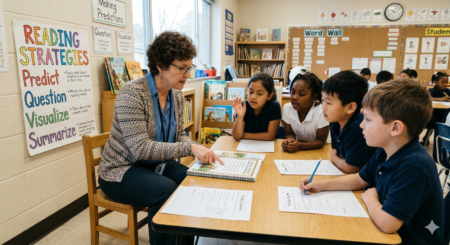
These three reading strategies are especially useful in elementary classrooms. Predicting encourages students to think ahead and stay engaged. Questioning helps them monitor their understanding. Summarizing asks them to identify what matters most. Together, these routines strengthen core comprehension skills without overwhelming students.
- Predicting: “What do you think will happen next, and why?”
- Questioning: “What is one question you still have after this paragraph?”
- Summarizing: “Tell the most important idea in one or two sentences.”
Use short texts for focused practice
You do not need a long novel to teach reading comprehension. Short passages, picture books, classroom articles, and printable worksheets often work better because they let students focus on one strategy at a time. For example, a second-grade teacher might use a short nonfiction passage about butterflies and ask students to highlight details that support the main idea. A fourth-grade teacher might use a narrative paragraph and guide students to infer how a character feels.
Short texts are also easier to revisit. Teachers can model once, practice together, and return to the same passage the next day for deeper discussion. That repeated exposure makes comprehension instruction more effective and less rushed.
When planning lessons, try this simple sequence: model the skill, practice it together, then let students try it independently. That gradual release structure is one of the most reliable ways to teach reading comprehension in a way students can actually transfer to new texts.
Classroom Activities That Build Comprehension Skills Every Week
If you want to teach reading comprehension consistently, classroom routines matter as much as individual lessons. Students improve when they practice often in predictable ways. The goal is not to create more work, but to build simple habits that fit naturally into literacy time.
Turn comprehension into a daily routine
Daily comprehension practice can be short and still be meaningful. A five-minute partner retell, a sticky-note inference, or an exit ticket about the main idea can all strengthen understanding. These small tasks are easier to sustain than long packets, and they give teachers quick insight into student progress.
One effective routine is the “stop and jot.” During reading, students pause and write one sentence about a prediction, question, connection, or summary. Another useful option is a discussion stem such as “I know this because the text says…” This helps students support answers with evidence, which is a key part of strong comprehension skills.
Use collaborative talk to deepen understanding
Want students to think more deeply about what they read? Let them talk. Turn-and-talks, partner reading, and small-group discussions make comprehension visible. When students explain ideas aloud, teachers can hear misunderstandings early and respond right away.
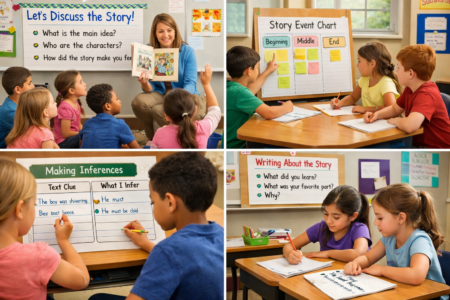
Imagine a third-grade classroom reading a folktale. After one page, the teacher asks, “What lesson do you think the story might teach?” Students share ideas with partners before the class discusses them together. That short conversation helps students test their thinking, hear new perspectives, and refine their answers. It is a practical way to teach reading comprehension while building speaking and listening skills at the same time.
- Interactive read-alouds with think-aloud pauses
- Reading journals for quick written reflections
- Printable worksheets focused on one skill at a time
- Small-group instruction for targeted support
- Exit tickets for fast comprehension checks
How to Teach Reading Comprehension for Different Learners
Every elementary classroom includes students with different reading levels, language backgrounds, and learning needs. That is why teachers need flexible ways to teach reading comprehension. The most effective support is often not more material, but better scaffolding.
Scaffold without lowering expectations
Students who need extra support can still work on grade-level thinking when teachers provide the right tools. Visuals, sentence stems, pre-taught vocabulary, and chunked text all make comprehension more accessible. For example, before reading an informational text, introduce three key words and show simple images. Then ask students to use those words during discussion. This builds confidence and improves understanding.
For English learners, oral rehearsal is especially helpful. Let students say an answer to a partner before writing it down. For struggling readers, shorter passages and guided reading questions can reduce frustration while keeping the focus on meaning. For advanced readers, ask for deeper inferences, text-to-text connections, or written evidence.
Keep materials organized and reusable
Teachers already juggle lesson planning, grading, and classroom management. Reusable classroom resources make it easier to teach reading comprehension across the week. Try keeping folders of printable worksheets sorted by skill, such as main idea, sequencing, inferencing, and cause and effect. That way, you can quickly match practice to what students need.
This is also where customizable tools can save time. If you use editable reading activities or AI-supported classroom resources, you can adapt the same lesson for multiple reading levels instead of building everything from scratch. For teachers who want a simple starting point, Didaktos offers time-saving materials that can support differentiated reading practice in everyday classrooms: https://didaktos.io/.
Common Mistakes to Avoid When You Teach Reading Comprehension
Even strong literacy lessons can miss the mark when comprehension becomes too broad or too rushed. If students are not growing, the issue may not be effort. It may be the structure of the instruction itself.
Doing too much at once
One common mistake is trying to cover too many reading strategies in a single lesson. When students are asked to predict, summarize, identify the main idea, infer, and analyze character traits all at once, they often lose focus. Instead, choose one goal and practice it well. Clear instruction helps students succeed faster.
Skipping modeling and discussion
Another mistake is assigning a passage without showing students how to think through it. To teach reading comprehension effectively, teachers need to model their own thinking and create time for discussion. Why would students know how to infer or summarize if they have never heard the process out loud?
It also helps to avoid making every comprehension task feel like a test. Some of the best practice happens in conversation, partner work, and low-pressure written response. When students feel safe sharing ideas, they are more likely to take risks and explain their thinking honestly.
As you refine your instruction, ask yourself: Are students practicing one clear skill? Do they have enough support? Are they talking about the text in meaningful ways? Those small shifts can transform how you teach reading comprehension from a routine task into a lasting reading habit.
Key Takeaways
- To teach reading comprehension well, model your thinking and focus on one strategy at a time.
- Short texts, partner talk, and quick written responses build strong comprehension skills without overwhelming students.
- Simple scaffolds, reusable classroom resources, and differentiated practice help all learners succeed.
Learning how to teach reading comprehension in elementary school does not have to feel overwhelming. Start with explicit modeling, use manageable reading strategies, and build small routines that fit your day. As students practice predicting, questioning, summarizing, and discussing texts, their confidence grows. For more teacher-friendly classroom resources and customizable tools that support reading instruction, explore Didaktos here: https://didaktos.io/.