
Every teacher has seen it: a student can read the words on the page but struggles to explain what the text actually means. That gap is exactly why strong reading comprehension strategies matter. In busy elementary classrooms, teachers need routines that build understanding without adding hours of prep. The good news? Effective comprehension instruction does not have to be complicated. With the right mix of modeling, discussion, and purposeful practice, students can strengthen reading skills across subjects. Whether you are teaching fiction, nonfiction, science texts, or short passages, the best strategies help students think while they read, not just answer questions after. So which approaches truly make a difference? Below, you will find practical methods, classroom reading activities, and time-saving ideas that teachers can start using right away.
Table of Contents
- Why reading comprehension instruction needs explicit strategy teaching
- Whole-group reading comprehension strategies that improve understanding
- Small-group and independent classroom reading activities that build transfer
- How to choose, adapt, and assess comprehension strategies in real classrooms
Why Explicit Reading Comprehension Strategies Matter
Many students do not automatically know how to make meaning from a text. They may decode accurately, but they still need support to identify important ideas, connect information, and monitor understanding. That is where explicit reading comprehension strategies come in. When teachers model thinking step by step, students begin to see what proficient readers actually do.
Think about a typical reading block. If students only read and answer questions, some will guess, some will skim, and some will wait for others to do the thinking. But when instruction includes predicting, questioning, summarizing, and clarifying, students gain tools they can use again and again. Isn’t that the goal of lasting reading instruction?
Teach the “why” behind the strategy
A strategy works best when students know when and why to use it. For example, summarizing helps readers stop and identify the big idea. Asking questions helps them notice confusion and stay engaged. Making connections helps them relate new information to prior knowledge. These are not random classroom routines. They are habits of strong readers.
Use before, during, and after reading routines
Effective comprehension instruction is not limited to the end of a lesson. Before reading, activate background knowledge and preview vocabulary. During reading, pause for think-alouds, stop-and-jot notes, or partner talk. After reading, ask students to summarize, cite evidence, or compare ideas. This structure is especially helpful for elementary teachers who need simple systems that work across multiple texts and subjects.
A practical example: before a nonfiction article, ask students to predict what they will learn based on headings and images. During reading, have them underline one key detail in each section. After reading, they write a two-sentence summary. That sequence takes only a few minutes, but it builds strong reading skills over time.
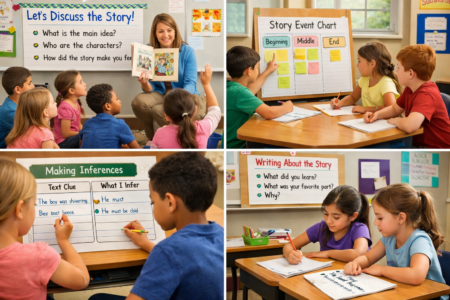
Whole-Group Reading Comprehension Strategies Teachers Can Model
Whole-group instruction is the best place to introduce new strategies because it allows teachers to model the invisible thinking behind comprehension. Students need to hear how a skilled reader notices clues, asks questions, and repairs confusion. When done consistently, this kind of modeling can transform passive readers into active thinkers.
Think-alouds make comprehension visible
A think-aloud is one of the most effective reading comprehension strategies because it shows students exactly what happens in a reader’s mind. While reading a short passage aloud, pause to say things like, “This part makes me think the character is nervous because of the way she keeps looking at the door,” or “I’m confused by this paragraph, so I’m going to reread it.” These moments normalize reflection and problem-solving.
For teachers, think-alouds are low prep and flexible. They work with read-alouds, shared reading, and content-area texts. In one 4th grade classroom, a teacher used a science article during morning meeting and modeled how to identify the main idea from headings, captions, and repeated terms. Students later applied the same routine in small groups with much more confidence.
Annotation and stop-and-jot routines keep students engaged
Another strong whole-group routine is text annotation. Younger students can use symbols like a star for important information or a question mark for confusing parts. Older students can highlight evidence, write margin notes, or track themes. These small written responses turn reading into active processing.
Stop-and-jot routines are especially useful when time is tight. Pause every few paragraphs and ask students to write one sentence: What happened? What did you learn? What is the author trying to say here? These quick checkpoints support classroom reading activities without requiring long written assignments.
For more ideas on modeling authentic literacy moves, many teachers also explore resources from Edutopia alongside their own classroom resources.
Small-Group and Independent Classroom Reading Activities That Build Transfer
Once students have seen a strategy modeled, they need chances to practice it with support. This is where small-group instruction and independent tasks matter. The goal is transfer: students should begin using comprehension moves on their own, even when the teacher is not standing beside them. How do you make that happen in a real classroom with mixed readiness levels?
Reciprocal teaching builds discussion and accountability
Reciprocal teaching is a reliable structure for guided reading groups. Students rotate roles such as predictor, questioner, clarifier, and summarizer. Each role reinforces a specific comprehension habit, and the conversation itself helps students process the text more deeply. This routine works especially well with short nonfiction passages, literature circles, or intervention groups.
One teacher-friendly adaptation is to assign just two roles at first instead of four. For example, one student asks a question and another gives a summary. Keeping the routine simple helps students focus on meaning rather than procedures. Over time, you can add more roles as reading skills improve.
Graphic organizers and short written responses support independence
Graphic organizers remain effective because they reduce cognitive load. A cause-and-effect chart, story map, or main-idea organizer gives students a clear place to record thinking. They are especially helpful for multilingual learners and students who need more visual structure.
Pair organizers with short written responses for even better results. After reading, ask students to answer one focused prompt using evidence from the text. This could be as simple as, “What is one problem in the text, and how was it solved?” or “What does the author want readers to understand?” These tasks work well as centers, exit tickets, or printable worksheets for extra practice.
When teachers combine discussion, visual supports, and short writing, students begin using comprehension tools across settings. That is when strategies start to stick.
How to Choose Reading Comprehension Strategies for Different Learners
Not every strategy works equally well for every student, text, or lesson goal. A strong teacher does not simply collect activities. Instead, they match the strategy to the challenge in front of them. Is the text complex? Are students struggling with vocabulary? Do they need help identifying the main idea or making inferences? The answers should guide your choice.
Match the strategy to the text demand
For narrative texts, retelling, sequencing, and character inference often work well. For informational texts, summarizing, questioning, and identifying text structure are usually more effective. If students are reading a science article, a heading walk and main-idea organizer may be more useful than a story map. That sounds obvious, but in busy lesson planning, teachers often reuse the same routine for every kind of text.
Differentiate without creating four separate lessons
Differentiation does not have to mean starting from scratch. You can keep the same comprehension goal while adjusting the support. For one group, you might provide sentence stems. For another, you might reduce the amount of text. Advanced readers might compare two passages or justify an inference with multiple pieces of evidence.
Here is a simple mini-case study: during a nonfiction unit, a 3rd grade teacher used the same article with the entire class. One group annotated key details with color-coded sticky notes. Another used a teacher-created organizer with guiding questions. A third group wrote a brief summary paragraph independently. The comprehension target stayed the same, but the support matched student needs.
This approach saves time, respects learner differences, and makes classroom resources more manageable. For elementary teachers balancing multiple subjects, that kind of flexibility is essential.
How to Know If Your Comprehension Instruction Is Working
Teachers often ask an important question: if students complete the activity, does that mean they truly understood the text? Not always. Effective reading comprehension strategies should lead to better thinking, stronger discussions, and clearer evidence in student responses. The best way to check progress is through small, consistent assessments built into instruction.
Listen to student talk
Partner discussions, guided reading conversations, and turn-and-talk moments reveal a lot. Are students using academic language? Can they explain their thinking? Can they point to text evidence? When student talk improves, comprehension is usually improving too.
Use fast formative checks
You do not need a long quiz every time. Exit tickets, one-sentence summaries, sticky-note responses, and brief written reflections can show whether students understood the text and applied the target strategy. These checks also help with lesson planning because they tell you whether to reteach, extend, or move on.
A useful pattern is this: model the strategy on Monday, guide practice on Tuesday and Wednesday, use independent application on Thursday, and check transfer on Friday with a new short passage. That simple cycle makes it easier to see growth over time without overwhelming students or teachers.
- Look for independence: Can students use the strategy without prompts?
- Look for evidence: Are responses grounded in the text?
- Look for transfer: Can students apply the same move to a different text?
When those three signs appear, your comprehension instruction is likely moving in the right direction.
Key Takeaways
- Reading comprehension strategies are most effective when teachers explicitly model how and why to use them.
- Students need a balance of whole-group modeling, small-group practice, and independent application to build lasting reading skills.
- The best strategy depends on the text, the learner, and the instructional goal, so flexible planning matters.
Strong comprehension instruction does not come from doing more activities. It comes from choosing the right routines and using them consistently. If you are exploring ways to save planning time while creating differentiated reading supports, tools like Didaktos can help you generate classroom resources, printable worksheets, and text-based activities that align with your goals. For teachers comparing options and refining their reading instruction, that kind of support can make implementation much easier.