
Every teacher knows the feeling: you find a text that is almost right for your lesson, but the vocabulary is too hard, the topic does not connect to your students, or the comprehension questions miss the skill you actually need to teach. That is exactly why many elementary teachers decide to create reading passages instead of relying only on textbooks or random online texts. When you write your own passage, you can match the reading level, target a specific standard, and build classroom resources that fit your lesson planning goals. You can also make printable worksheets that save time later. So where do you start? And how do you make sure the passage is useful, not just “cute”? This guide walks you through a practical process to create reading passages your students can actually learn from, with simple examples you can adapt right away.
Table of Contents
- Why teachers create custom reading passages
- How to create reading passages step by step
- Reading passage examples by grade level
- How to turn passages into printable classroom materials
- Common mistakes to avoid
Why Teachers Create Custom Reading Passages
When you create reading passages for your own classroom, you gain control over one of the hardest parts of reading instruction: alignment. Instead of forcing students through a text that is too long, too abstract, or full of unrelated vocabulary, you can build a passage around the exact skill you want to teach. That might be identifying the main idea, making inferences, comparing two texts, or using context clues.
When published texts are not the right fit
Have you ever found a passage that matched the topic but not the reading level? Or one that worked for half your class but lost the other half in the first paragraph? Custom writing helps solve that problem. You can shorten the text, simplify sentence structure, and choose familiar topics that lower the cognitive load. That is especially helpful for elementary teachers who are differentiating for mixed-ability groups, multilingual learners, or students who need more confidence before tackling grade-level text.
The value of relevance and differentiation
Students read more carefully when the topic feels close to their world. A third-grade class may respond better to a passage about a school garden, a lost library book, or a rainy field trip than a generic text pulled from a workbook. One teacher might write three versions of the same passage: one shorter version with picture support, one on-level version, and one extension version with richer vocabulary. Same skill, different access points. That is one of the biggest reasons teachers create reading passages: they become flexible classroom resources instead of one-size-fits-all materials.
Custom passages also support better lesson planning. When your text, questions, and objective all work together, the lesson feels smoother, and assessment becomes more meaningful. Instead of asking, “Why did students miss this question?” you can ask, “Did the text truly measure the skill I taught?” That shift matters.
How to Create Reading Passages Step by Step
The fastest way to create reading passages is to start with the teaching goal, not the topic. Teachers often do the opposite: they pick a fun theme first, then try to force a comprehension skill into it. A better workflow is to decide what students should practice, then build the text around that purpose.
Start with the skill and the reader
Ask yourself four simple questions before you draft: What skill am I teaching? Who is the passage for? How long should it be? What background knowledge do students need? These questions keep the writing focused. A passage for first graders practicing sequencing will look very different from a passage for fifth graders working on inferencing. The objective should shape the vocabulary, sentence length, and structure from the beginning.
- Choose one comprehension target. Keep it narrow, such as main idea, character traits, cause and effect, or text evidence.
- Select a familiar topic. Use themes students know: pets, weather, recess, community helpers, science observations, or classroom routines.
- Set the length. Younger students may need 60-120 words. Upper elementary students may handle 150-300 words depending on the task.
- Outline the text structure. Narrative, informational, or compare-and-contrast?
- Draft with simple, clear sentences. Vary sentence length, but avoid stuffing too many ideas into one line.
- Revise for purpose. Remove any sentence that does not support the skill.
Draft, revise, and test for clarity
Once you have a draft, read it like a student would. Is there a logical flow from beginning to end? Are there too many unfamiliar words clustered together? Can a student answer the target question using the text alone? This is where strong reading passage examples help. Good passages do not try to do everything at once. They focus on one main learning goal and give students enough support to succeed.
A helpful rule is this: challenge the skill, not the decoding. In other words, do not make the vocabulary, sentence structure, and content all difficult at the same time unless that is the actual goal. If students are struggling, ask yourself: are they missing the comprehension skill, or are they just overwhelmed by the text?
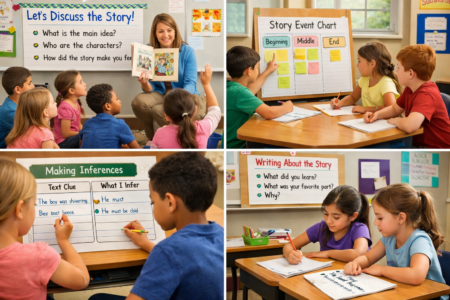
Reading Passage Examples by Grade Level
Sometimes the easiest way to create reading passages is to study a few models. Below are two short reading passage examples that show how the same process can work across grade levels. Notice how the topic, sentence length, and question type change based on student needs.
Example for K-2 students
Skill: Sequencing
Mia planted a bean seed in a small cup. First, she filled the cup with soil. Next, she placed the seed inside and covered it. Then, Mia poured in water and set the cup by the window. After a few days, she saw a tiny green sprout.
This short passage works because the sequence words are clear, the topic is concrete, and the sentences are manageable. A teacher could ask: What did Mia do first? What happened after she added water? Students can retell the steps orally, cut and paste picture cards, or complete printable worksheets using the same text.
Example for grades 3-5
Skill: Main idea and supporting details
On Fridays, Room 12 runs a classroom store. Students earn points during the week for finishing work, helping classmates, and following routines. At the store, they can “buy” bookmarks, pencils, or extra drawing time. The classroom store is fun, but it also teaches students how to budget, make choices, and wait for something they want.
Here, the topic is engaging and school-based, which helps students connect quickly. The main idea is supported by several clear details. A teacher could ask students to identify the sentence that best states the main idea, explain which details support it, or write a new title for the passage. That is the power of well-designed reading passage examples: they are simple enough to teach from, but rich enough to discuss.
- K-2 tip: Use repetitive sentence patterns and visible sequence words.
- 3-5 tip: Add one layer of abstraction, but keep the paragraph tightly focused.
- For all grades: Match question difficulty to the purpose of the lesson, not just the age level.
How to Turn Your Text Into Printable Reading Passages
Writing the passage is only half the job. Teachers also need materials that are easy to print, assign, and reuse. When you create reading passages with classroom use in mind, you save time later and build better systems for lesson planning. A strong passage can become a small-group task, homework page, literacy center activity, or quick assessment with just a few formatting choices.
Add questions that match the text
Keep the questions tightly connected to the target skill. If the passage was written to teach inferencing, the questions should not suddenly focus on author’s purpose or figurative language. Start with two or three text-dependent questions, then add one extension task if needed. For example, after an informational passage, you might ask students to underline evidence, summarize the text in one sentence, or compare it to a science lesson from earlier in the week.
Format for speed and classroom use
Good printable reading passages are easy to scan. Use clear headings, readable font sizes, and enough white space for students to annotate. Keep answer lines realistic. Avoid cramming too much text onto one page just to save paper. Classroom resources should reduce friction, not create it. A simple one-page passage with one-page questions is often more effective than a crowded two-page sheet.
This is also where digital tools can help. Instead of rewriting the same format every week, teachers can build a repeatable template for title, passage, questions, and answer key. If you want a faster workflow for generating editable reading materials, tools like Didaktos can support drafting and customization without turning the lesson into a hard sell or a tech headache. The goal is simple: less formatting time, more teaching time.
Mistakes to Avoid When You Create Reading Passages
Even experienced teachers can overcomplicate a passage. That usually happens when we try to make the text “rigorous” by adding too much vocabulary, too many ideas, or questions that do not reflect the objective. Strong passages feel clean and intentional.
Too much difficulty at once
Be careful not to overload students with unfamiliar content, complex syntax, and advanced vocabulary in the same short text. Rigor is not the same as confusion. If the real goal is practicing character traits, students should not also need to decode five domain-specific terms just to access the paragraph. A better approach is to introduce one meaningful challenge at a time.
Questions that miss the purpose
Another common issue is writing a good passage but weak follow-up questions. Why spend time to create reading passages if the assessment does not show what students understood? Keep the questions aligned, specific, and answerable from the text. Avoid vague prompts like “What do you think?” unless the lesson truly calls for open-ended response.
- Avoid: passages that wander off-topic halfway through.
- Avoid: comprehension questions that require background knowledge not provided in the text.
- Avoid: answer choices that are tricky in a test-like way but not instructionally useful.
- Do instead: revise with your objective, grade level, and student supports in mind.
The best custom passages are not the most elaborate ones. They are the ones students can read, think about, and discuss with success. That is what makes them truly useful classroom resources.
Key Takeaways
- Start with the comprehension skill first, then choose a topic and text structure that support it.
- Use familiar, relevant topics so students can focus on meaning instead of unnecessary confusion.
- Turn your draft into printable reading passages with aligned questions, clear formatting, and reusable templates.
If you want to create reading passages more efficiently, start with one upcoming lesson this week. Draft a short text for a single skill, test it with a small group, and revise based on student responses. Once you have a repeatable process, creating your own passages becomes much faster. And if you want extra support building editable, teacher-friendly materials, explore Didaktos as a practical next step.